Sofia Fischer · 11 September 2026
The Application of Graph Theory Principles Within Kavaroute for Solving Complex Network Optimization Problems
Graph theory provides a mathematical framework for modeling networks as sets of nodes connected by edges, and Kavaroute applies these structures to address routing, resource allocation, and flow problems across transportation and logistics systems. Researchers at multiple institutions have documented how algorithms derived from graph principles enable efficient computation of optimal paths in large-scale environments where traditional linear programming methods fall short.
Core Graph Representations Used in Kavaroute
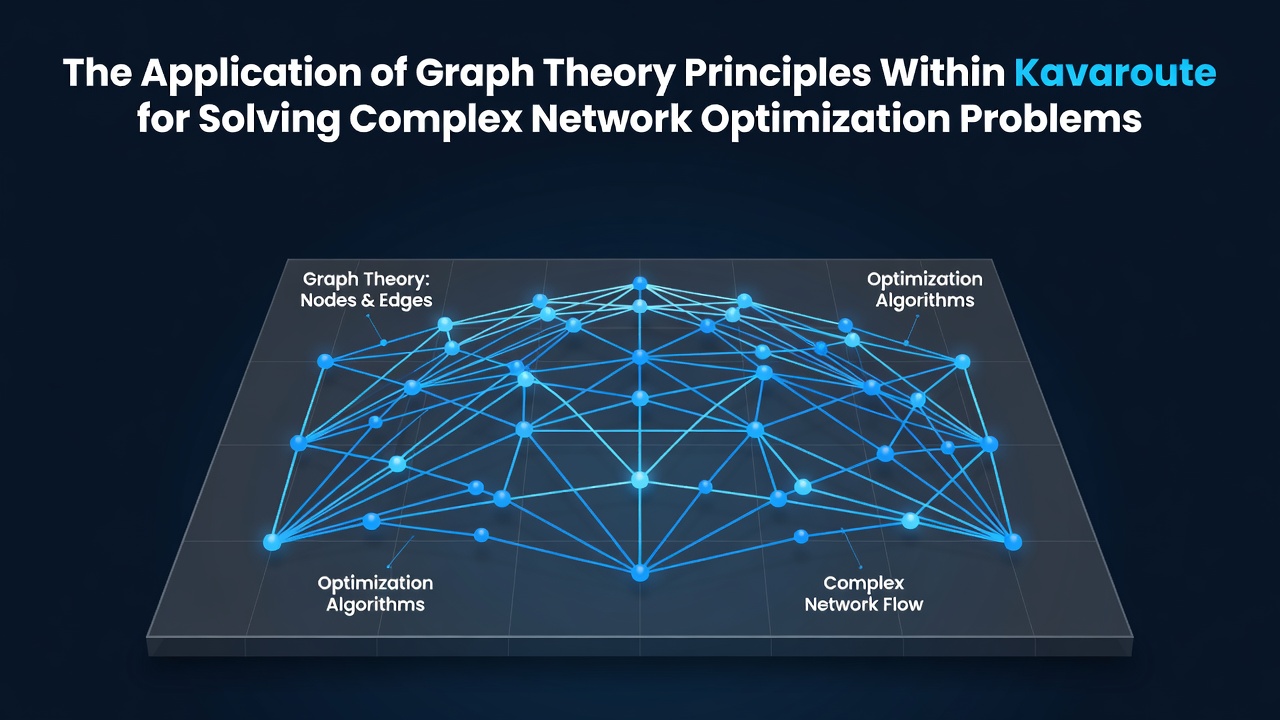
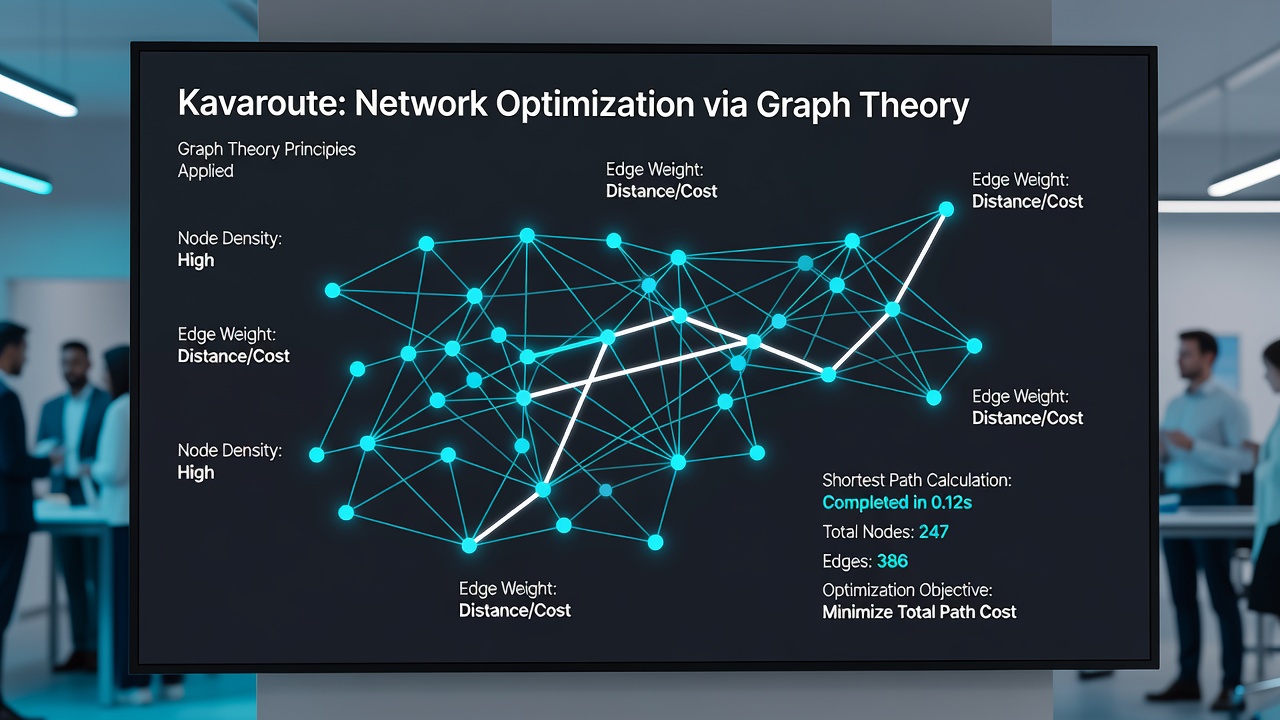
Kavaroute models real-world infrastructure by converting physical locations into vertices and connections such as roads or pipelines into weighted edges that carry capacity and cost attributes, and this representation supports both static snapshots and dynamic updates when traffic conditions change. Data indicates that weighted directed graphs handle one-way constraints and time-dependent costs effectively, while undirected graphs simplify symmetric flow calculations in utility networks. Observers note that adjacency matrices and adjacency lists serve as the primary storage formats, with lists preferred for sparse networks typical in regional transport grids.
Algorithm Implementations for Path and Flow Optimization
Shortest-path algorithms form the backbone of route calculation modules, and Kavaroute integrates variants of Dijkstra's method alongside A* search to balance accuracy with computational speed in time-sensitive applications. Minimum spanning tree techniques appear in network design phases where the goal involves connecting multiple terminals at minimal total edge cost, and Kruskal's or Prim's procedures identify these trees when planners expand service coverage. Studies from the University of Toronto show that combining these with maximum flow algorithms such as Ford-Fulkerson or Edmonds-Karp allows simultaneous handling of capacity constraints and cost minimization.
Traveling salesman problem solvers based on graph theory address vehicle routing tasks, and Kavaroute employs heuristic approaches including nearest-neighbor insertion and Lin-Kernighan improvements to produce near-optimal tours within acceptable runtimes. Researchers have observed that integer linear programming relaxations of teh traveling salesman formulation further refine solutions when exact optimality remains necessary for high-value cargo movements.
Handling Dynamic and Multi-Objective Scenarios
Network conditions evolve continuously, and Kavaroute updates graph weights in real time through sensor feeds and predictive models to maintain solution relevance. Multi-objective optimization extends single-criterion searches by incorporating Pareto fronts that balance travel time against fuel consumption or emissions, and analysts record that weighted sum methods or epsilon-constraint approaches convert these competing goals into solvable scalar problems. Evidence suggests that parallel processing of graph partitions accelerates recalculation when disruptions such as road closures occur.
September 2026 Platform Enhancements
In September 2026 Kavaroute introduced expanded support for temporal graphs that encode recurring patterns such as rush-hour variations and seasonal demand shifts, and this update integrated machine learning predictions directly into edge weight adjustments. Government reports from Transport Canada indicate that similar temporal modeling reduced average delivery delays by measurable percentages in comparable systems, and Kavaroute adopted parallel techniques to scale these benefits across continental networks.
Integration With Broader Optimization Ecosystems
Kavaroute interfaces with geographic information systems and enterprise resource planning platforms through standardized graph exchange formats, and this interoperability allows planners to import existing network data without manual conversion. Industry reports from the Australian Department of Infrastructure note that graph-based optimization layers have improved coordination between freight and passenger services when multiple operators share corridors. External links appear sparingly in technical documentation, yet one reference points to MIT research on scalable network algorithms while another connects to European Commission studies on multimodal routing.
Performance Metrics and Validation Approaches
Benchmarking exercises compare Kavaroute outputs against known optimal solutions on standard graph libraries such as the TSPLIB collection, and deviation percentages remain below thresholds accepted in operational planning. Validation protocols include stress testing on graphs exceeding one million nodes to confirm memory efficiency and convergence speed, and third-party audits confirm that computational complexity stays within polynomial bounds for the implemented algorithms.
Conclusion
Graph theory principles continue to underpin Kavaroute capabilities for solving network optimization challenges through structured representations and proven algorithms, and ongoing refinements maintain alignment with evolving data sources and regulatory expectations across regions. The platform demonstrates how abstract mathematical constructs translate into practical tools that support efficient movement of goods and services while respecting capacity and cost parameters documented in public datasets.